Maths
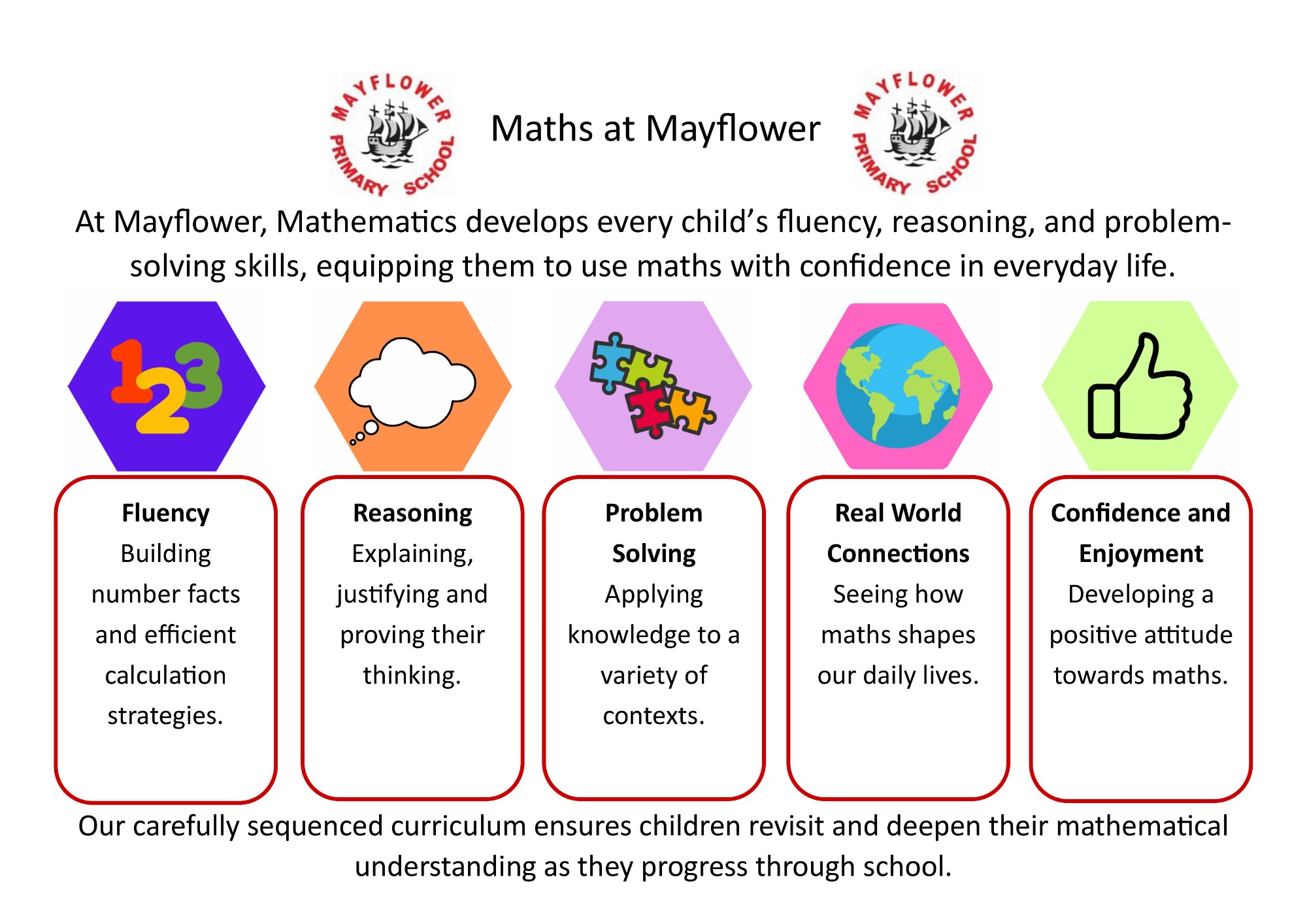
We follow the National Curriculum for maths. Mathematics is a critical life skill. Here at Mayflower, we strive to make maths relevant, exciting! Through teaching and learning in this area we aim to develop children's confidence and enthusiasm in using and applying mathematical skills and knowledge to the world around them. Mathematics is taught through a Mastery approach, which is underpinned by these 5 big ideas.
Coherence
Teaching is designed to enable a coherent learning progression through the curriculum, providing access for all pupils to develop a deep and connected understanding of mathematics that they can apply and communicate in a range of contexts.
Representation and Structure
Teachers carefully select representations of mathematics to expose mathematical structure. The intention is to support pupils in ‘seeing’ the mathematics, rather than using the representation as a tool to ‘do’ the mathematics. These representations become mental images that students can use to think about and discuss mathematics, supporting them to achieve a deep understanding of mathematical structures and connections.
Mathematical Thinking
Mathematical Thinking is central to how pupils learn mathematics and includes looking for patterns and relationships, making connections, conjecturing, reasoning, and generalising. Pupils should actively engage in mathematical thinking in all lessons, discussing and communicating their ideas using precise mathematical language.
Fluency
Efficient, accurate recall of key number facts and procedures is essential for fluency, freeing pupils’ minds to think deeply about concepts and problems, but fluency demands more than this. It requires pupils to have the flexibility to move between different contexts and representations of mathematics, to recognise relationships and make connections, to explain their ideas and to choose appropriate methods and strategies to solve problems.
Variation
The purpose of variation is to draw closer attention to a key feature of a mathematical concept or structure through varying some elements while keeping others constant. Through variation the teacher focuses thinking and discussion on the key feature in question
Conceptual variation
Involves varying how a concept is represented to draw attention to critical features. Often more than one representation is required to look at the concept from different perspectives and gain comprehensive knowledge.
Procedural variation
Considers how the student will ‘proceed’ through a learning sequence. Purposeful changes are made in order that pupils’ attention is drawn to key features of mathematics, scaffolding students’ thinking to enable them to reason logically and make connections.